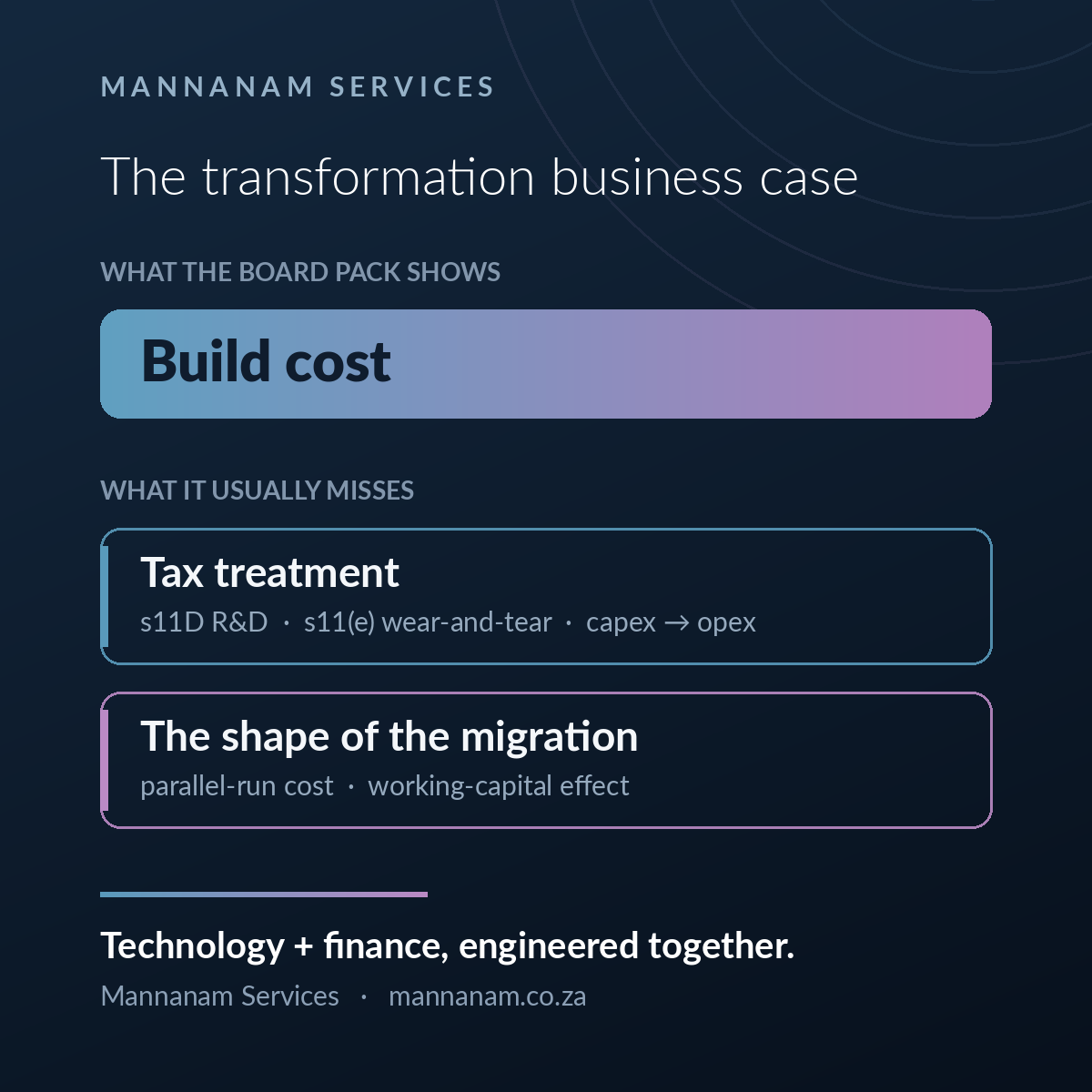
Most technology business cases we see in South African enterprises model one number well — build cost — and miss the two that actually decide whether the investment pays off.
The first number: tax treatment
A modernisation programme isn't a single line item to SARS. Software you build in-house may qualify for the section 11D R&D deduction. Hardware and qualifying infrastructure attract wear-and-tear allowances under section 11(e). Shift that same spend to a cloud subscription and the capex-to-opex change rewrites the deductibility profile entirely.
The cash impact runs into real money — and it rarely appears in the board pack.
The second number: the shape of the migration
The financial shape of the migration itself is the other blind spot: the dip in delivery capacity while teams run two systems, the parallel-run cost, and the working-capital effect of a payment model that moves from an upfront licence to a monthly subscription.
None of this shows up in a build estimate. All of it shows up in the cash flow.
Built in separate rooms
A CTO builds the architecture case. A CFO builds the financial one. They are usually built in separate rooms, and the gaps between them are where transformation budgets quietly bleed.
That gap is the entire reason we run technology and finance under one roof. When the architecture and the financial model are built by the same firm, the tax position and the cash impact are designed in from the start — not discovered in year two.
If your next transformation case has a strong technology argument and a thin financial one, that's worth a conversation.